Staccato Spotlight: Dr. Ward Miller
Dr. Ward Miller
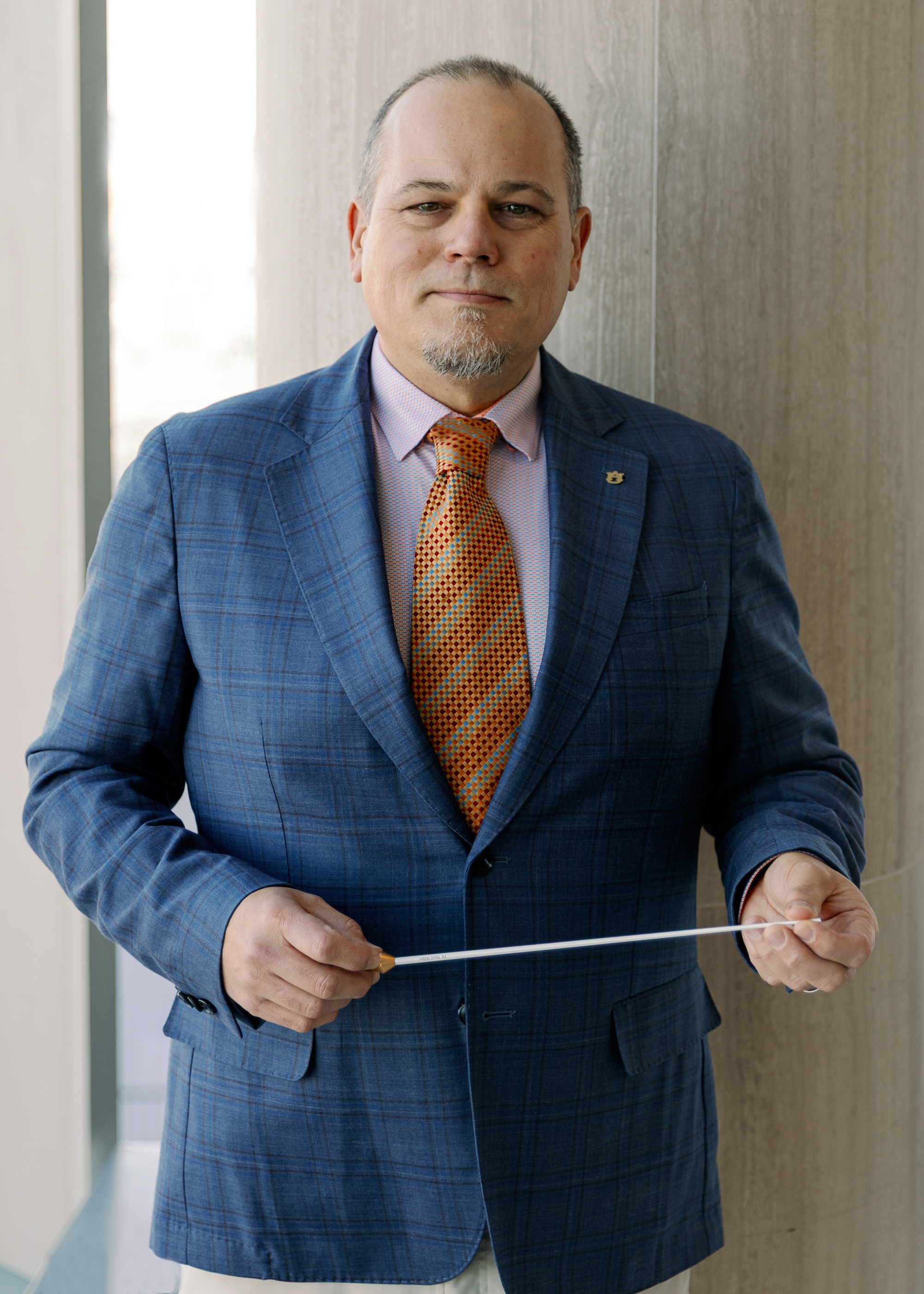
is a conductor, arranger, and music educator based in Minneapolis. He holds degrees from Auburn University, Arizona State University, and the University of Iowa, where he earned his D.M.A. in Band Conducting. Dr. Miller has served as Associate Director of Bands at the University of South Alabama and Brass Caption Head for the Blue Stars Drum and Bugle Corps. He is an accomplished arranger whose work has been featured in college marching bands, the Macy's Great American Marching Band, and EA Sports' College Football 2026 video game. He co-authored a textbook on error detection in wind bands and maintains consultancies with music programs nationwide.
How did you first get into arranging for marching band?
I started writing arrangements for small ensembles in 7th grade, like transcribing piano works for my friends and me to play for solo and ensemble festivals. My first was a transcription of the third movement of Mozart's Piano Sonata No. 11 "Rondo alla Turca" for myself on trombone and a flute performer. By my senior year of high school, my band director Mr. John Lee was kind enough to let me arrange music for the stands and for our field show. By my sophomore year at Auburn University, I was writing for the AU Marching Band in the stands and on the field by permission of Dr. Rick Good and with the help of my arranging teacher Dr. Johnnie Vinson. And from those beginnings it has grown to a career, writing for that ensemble and others across the country and world for almost 30 years now.
How is writing for a marching band different from other kinds of arranging?
Each kind of arranging for each kind of ensemble varies because of the particular idiomatic needs of that audience, instrumentation, and venue. I think that marching band's particular arranging needs require you to focus on three needs of especial importance. Firstly, clarity of communication (i.e. lots of strong, clear sound mass and readable melodic content) for the large outdoor venue. That means you write in instrument ranges that are most likely to be strongly communicative. Secondly, you must balance interesting and exciting technical demands with the need for something to lay on the horn easily. Rehearsal time is at a premium, so it needs to sound exciting and technical while still allowing refinement in a short window of preparation time. And finally, you must balance audience accessibility with effective musical design. That means you need to write music that is recognizable and engaging to a large crowd, while still being creative in how you write for the band. It's not enough to just transcribe a work exactly as the artist wrote it, you also have to create interesting harmonies, textural shifts, pacing changes, and more to deliver a truly memorable work.
What parts of arranging for marching band might beginners overlook?
I think that many young arrangers, myself included when I began, lack the knowledge of individual instruments' practical ranges and technical hurdles. Only through seeking feedback from experts on those instruments can we learn about things like the pitfalls of going across the break in the clarinets' technical passages, or avoiding third valve in the brass for faster runs, or the tuning nightmares of the 6th and 7th partials of the brass. My strongest advice to young arrangers who seek it is to have their fellow band members in all sections look at what they wrote and tell them what "accidental hornet nests" they've planted in their arrangements. I'll never forget the advice of my clarinetist friend at Auburn, Heather Morgan, who looked at my first field arrangement and told me "See these notes? They're throat tones. Don't write those." I didn't know anything about that until an expert in the horn told me so. So use your friends' knowledge as a valuable resource, and get feedback from lots of people. It's not fun to be told what you're doing wrong, but it's the only way we grow as writers!
“...Use your friends’ knowledge as a valuable resource, and get feedback from lots of people. It’s not fun to be told what you’re doing wrong, but it’s the only way we grow as writers!”
What are some of the physical and acoustic realities of performing outdoors that tend to catch new arrangers off guard?
Marching band is a physical activity, and performers are often already fatigued when they hit the field for halftime from a day of playing and events for hours already. So it's important to keep that in mind when writing. Just because our lead trumpets "can play a high C" doesn't mean they can stay in that range for long periods throughout the show. It's better to give breaks to individual sections so they have some time to rest their faces and catch their breath. This is also a good design principle that ensures good variation in texture throughout an arrangement or show. Also, it's important to double parts often for the outdoor space. If only the mellophones have the melody, we may have trouble clearly communicating that in an outdoor space because of a lack of numbers, but also because the performers are spread out from each other on the field. Performers will always play more confidently and strongly if they're standing near multiple people who are playing the same lines that they are. So don't score too thinly!
When you sit down to arrange a piece, where do you actually start, and does that process change depending on the source material?
This process has changed a lot and for the better thanks to the technology now available to us. I always start by just listening to the original recording a few times and imagining how I would recreate those moments and harmonies. I also make sure I have a thorough understanding of the instrumentation numbers, capabilities, and limitations of the target ensemble, be it a specific client or a general ability/grade level. Throughout all of this, I'm just mentally mapping out the form, key changes, and other large-scale ideas that I want to implement. Then, I open the audio recording in Logic Pro and use the stem splitter to separate the tracks. This makes it a lot easier to listen to individual lines like the bass, vocals, guitar, piano, etc. I then use that same software to transpose the recording into the desired key. Typically, I start by writing the bass line, then the harmony, then the melody and countermelody, for each phrase. As I follow this process the arrangement grows, adjusts, and takes shape. Often, after finishing the first draft, I'll step away from it, and in the middle of the night, or on the couch watching TV, or out for a walk, an idea for something that could improve the arrangement will burst into my brain. At that point I either step to my keyboard to work out that idea, or I sing into a voice note on my phone, or I write myself a digital note, so I don't lose that thought. Some of my best countermelodies, harmonic modulations, and effects have come from those "AHA!" moments.
How do you decide which instruments carry which parts of a song, especially when you're adapting something that wasn't written for a marching ensemble?
I think that as often as possible, it's important to choose instruments that convey the character of the timbre of the original voice or instrument. Warm, rich sounds? Conical brass and clarinets. Edgy electric guitar power chords? Trombones and saxes. Sparkling, bright, shimmery lines? Cylindrical brass in a higher tessitura paired with piccolos, flutes, and clarinets. Of course, all of that must be paired with using excellent range choices that ensure a quality sound and clear communication of that musical line. But one also needs to ensure that we have textural variety. So maybe that line shifts to a completely different voice simply to give that section a break and to give the audience's ears something new. We don't have smoke machines, lasers, reverb, lyrics, or tabloid scandals to drive interest in our music like the original artists do, so the arrangement must create additional interest through texture and color. This also ensures that every part of the band gets something fun to play!
What's the most common mistake you see new arrangers make, and what's usually the fix?
I think that the error novice marching band arrangers commit is making the arrangement sound exactly like the original recording. The original is great, but it was written for instruments with different idiomatic needs and tendencies. Don't try to put it in the original key unless it's a good key for marching band. Don't use the original tempo if it's too fast or slow for marching and audience engagement. Use the models of effective design at your disposal to fuse those principles with an accurate representation of the original work, and the resulting synthesis will be a winner for both audience and performer alike.
What resources (books, scores, recordings) would you point a new arranger toward?
A quick bookstore search will provide you with several great options for texts exploring this subject, and I would encourage folks to peruse those at their leisure. However, I believe that the strongest tool an arranger has is studying existing, effective arrangements. Was there an arrangement that really moved you, stuck with you? Look at their score and try to figure out how that writer made it happen. Study their voicing, their harmonies, and their countermelodies, and then try to recreate them in your own work. Even better, DON'T look at the score - just listen to the recording and try to transcribe it. I think it's also important to study the pacing of arrangements. Break out the stopwatch and see how long an arranger stuck with one texture before changing. How long did they build that phrase before an impact? How long did it last? Take the metadata of that arrangement, then apply it to your own.
Looking back at your career, what's something you had to learn the hard way that you'd pass on to someone starting out today?
I think that what I learned the hard way was that you can't just write whatever you want from a range and technique demand standpoint, because the limitations of your target ensemble will prevent the arrangement from achieving a fully realized performance. And if they don't feel success in how they execute the arrangement, then they're not going to hire you or buy your charts again. One of my favorite quotes on this subject I often paraphrase is from the great composer Igor Stravinsky, one of the most "free" and iconoclastic visionary voices of harmonic and compositional construction. In his "Poetics of Music in the Form of Six Lessons," he stated: "My freedom thus consists in my moving about within the narrow frame that I have assigned myself for each one of my undertakings. I shall go even further: my freedom will be so much the greater and more meaningful the more narrowly I limit my field of action and the more I surround myself with obstacles. Whatever diminishes constraint, diminishes strength. The more constraints one imposes, the more one frees one’s self of the chains that shackle the spirit.” So always set yourself within practical bounds on what you ask of the ensemble within the realms of range, technical demand, instrumentation, and more. The resulting work you do within those constraints will be all the greater in the end.
At this point in your career, what is your "1,000 foot wave"? (Something that you would like to do, but haven't had the chance to or something that you hope to create?)
Honestly, I only have three remaining arranging career goals. Firstly, I'd like to have my music appear in a major motion picture. Secondly, I'd love to work with a major popular recording artist on a collaboration with marching band. For example, I had so much success with the award-winning Metallica show at Auburn University that I'd love to see them perform with the original artists! And finally, I would love to see one of my stock arrangements for marching band go BIG, across the country and globe. I think that's the dream of all marching band writers, to have THE definitive arrangement of a popular chart performed by massive numbers of bands all over the world. Think Tom Wallace's arrangement of "Hey Baby," which gained a multi-decade life of its own that transcended generations and the original recording itself.
Why do you use ArrangeMe?
I use ArrangeMe because it allows so many more people to play and hear my music. When the copyright barriers have been lowered, and people can purchase, download, print, and perform a licensed copy of my charts, then it opens my custom works to a vast new field of directors, performers, and audiences. And I love that ArrangeMe allows me to create my own score demo videos, cover art, and more so I can showcase and differentiate my product in a crowded marketplace.
Connect with Dr. Ward Miller
Website: www.drwardmiller.com
Instagram: @drwardmiller
YouTube: @drwardmiller
Facebook: @drwardmiller