Copyright Notices: Why They Matter and How to Get Them Right
If you have uploaded arrangements to ArrangeMe, you have probably noticed the requirement to include copyright information at the bottom of your sheet music. It might seem like a small formatting detail, but it is actually one of the most important parts of your upload. Here is a closer look at what copyright notices do, why they matter for music specifically, and how to handle them correctly on ArrangeMe, whether you are arranging a popular song, working with public domain material, or your own composition.
What a copyright notice actually does
A copyright notice tells the world who owns a work and that it is protected. In the US and most countries, copyright protection kicks in automatically the moment a piece of music is affixed to any medium (e.g. music notation, recording, etc.). Registration of copyrighted material is not required for protection to exist, though it is encouraged if your catalog grows in volume and/or popularity. If you are curious about what this process entails, we recommend checking out the Copyright Office’s page on the subject, here.
Music copyright has extra layers
Copyright in music is a little more complex than in other creative fields, because most songs carry at least two separate copyrights. The first covers the underlying composition: the melody, harmony, and lyrics (divided into ‘writer’ and ‘publisher’ portions). The second covers the sound recording, if one exists. When you create a printed arrangement of a song, you are creating something called a derivative work, any creative work that's based on or adapted from someone else's existing copyrighted material. Even though your arrangement contains your own creative decisions, the original publisher still owns it. That is why you need a license before you can sell it, and why the copyright notice on your printed score needs to correctly credit that publisher.
What ArrangeMe requires for copyrighted songs
Hal Leonard/ArrangeMe licenses print music rights on behalf of publishers, which is what makes it possible for you to legally create and sell sheet music arrangements of popular songs. However, that license comes with conditions, and correctly including the correct copyright notice on your sheet music is one of the most important ones!
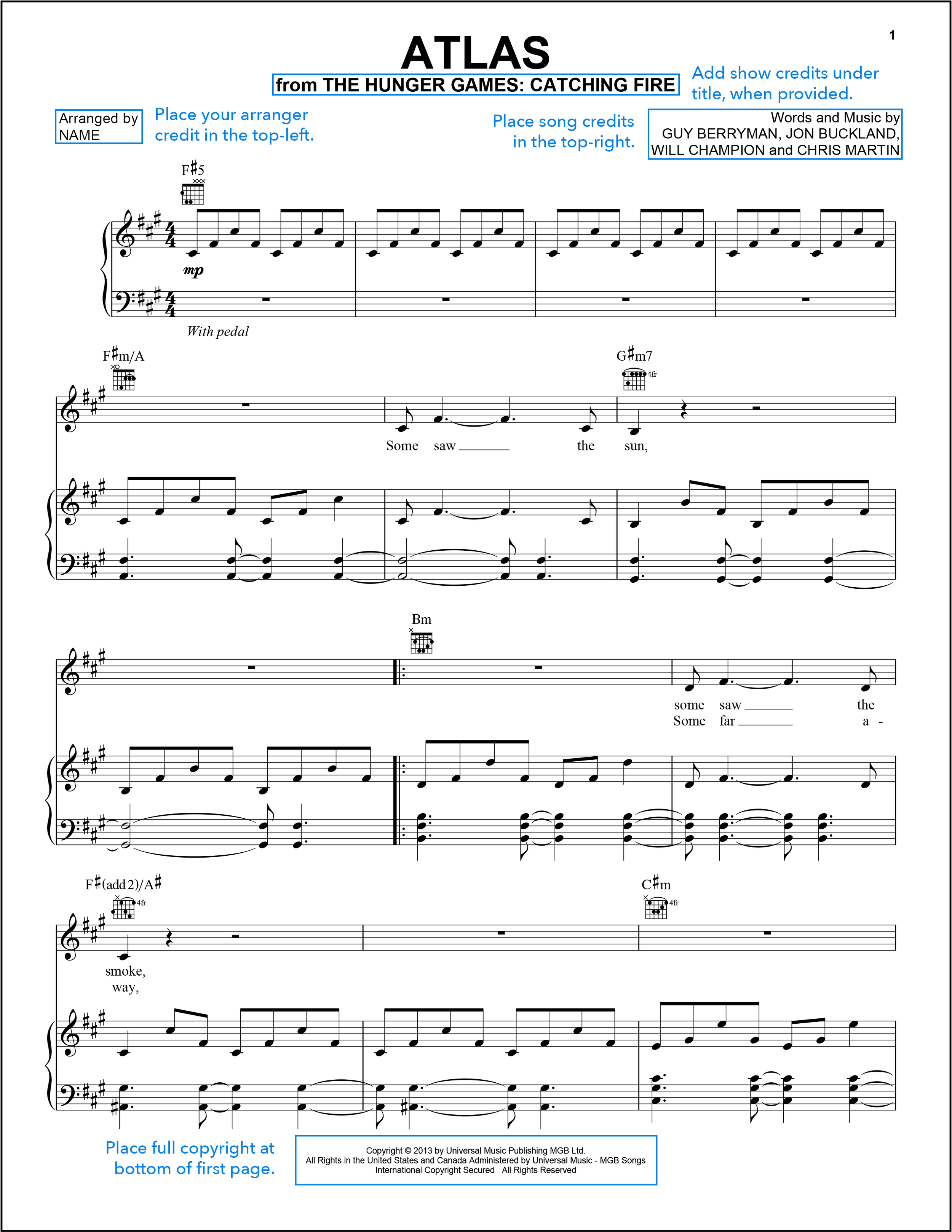
This template can always be found in our help center, here!
Quick how-to: In the Song Search, click on the title you have arranged. A window will appear with all the details for that song, including the full copyright text. Copy and paste the entire notice to the bottom of the first page of your sheet music. Do not paraphrase or abbreviate it. The exact wording matters, because it is how the publisher(s) and songwriter(s) get correctly credited and paid.
Getting the Song Search match right is just as important as the notice itself. Because many songs share titles, always search using the songwriter's name alongside the title (for example, "Hello Adele Adkins" rather than just "Hello"). The correct match is how royalties flow back to the people who created the original work, and uploading to the wrong title is a Terms of Use violation that can result in your arrangement being taken down.
What about public domain arrangements?
Great news: if you are arranging a work in the public domain (PD) worldwide, you do not need to go through the Song Search for a publisher copyright notice. Public domain music is free for anyone to arrange and sell as printed sheet music without a license fee. Think Bach, Beethoven, traditional folk songs, and most music published before 1931 in the US.
That said, you still need a copyright notice on your printed score! Here is why: while the original composition is in the public domain, your arrangement of that music is a new, original creative work. Your unique voicings, articulations, and editorial decisions are yours, and they deserve to be protected. Your notice should reflect that.
Using your name is generally okay for most creators, however, if you have a publishing company name officially set up with a Performance Rights Organization (PRO), you may choose to use that name in the © notice instead. This name is different from the Publisher Name associated with your ArrangeMe account, unless that name is the one that is officially registered with your PRO (ASCAP/BMI/etc.).
Example:
Arranged by [Your Name]
© 2026 [Your Name]. All rights reserved.
This arrangement is an original work based on a public domain composition.
A couple of things to keep in mind with PD works. First, double-check that the work is actually in the public domain worldwide before assuming. Copyright law is surprisingly nuanced, and the cutoff dates differ between countries/territories. If you are working from an existing published edition of a public domain piece, that specific printed edition may carry its own copyright even if the underlying music does not. When in doubt, work from the original source rather than a modern published edition.
For original compositions
If you are uploading an original piece you composed yourself, the same principle applies. You are the rights holder, so your notice names you. This helps to protect your printed score from being reproduced or distributed without your permission after someone purchases it.
Example:
© 2026 [Your Name]. All rights reserved.
How to add it: step by step
Use ArrangeMe’s Song Search to find the title you wish to arrange/publish. Include the songwriter's name to make sure you get the right match.
Click the title to open the details window. Copy the full copyright text exactly as it appears.
Paste it at the bottom of the first page of your score in a clear, legible font.
For public domain or original works, write your own notice as shown in the examples above.
Save your PDF without password protection, sized for standard home printing (8.5" x 11" or A4), under 15 MB.
“. . . that (print) license comes with conditions, and correctly including the correct copyright notice on your sheet music is one of the most important ones!”
The bigger picture
ArrangeMe works because publishers have agreed to make their catalogs available to arrangers like you (and us!). The copyright notice is an important part of honoring that agreement. It makes sure the original songwriters and publishers are credited and compensated, it protects your own work, and it tells customers that what they are purchasing is legitimate and fully licensed.
It takes about 30 seconds to add. And it really does matter!
One more thing: ArrangeMe only covers digital print music licenses. If your customers wish to perform your arrangement live, that is a different license they will need to secure separately. Most venues should have Performing Rights Organization (PRO) blanket licenses in place to cover this, but the performing ensemble should always double-check. Questions? Reach out to support@arrangeme.com.